

Copyright 2023 © All right reserved
The interiors of the Sanctuary


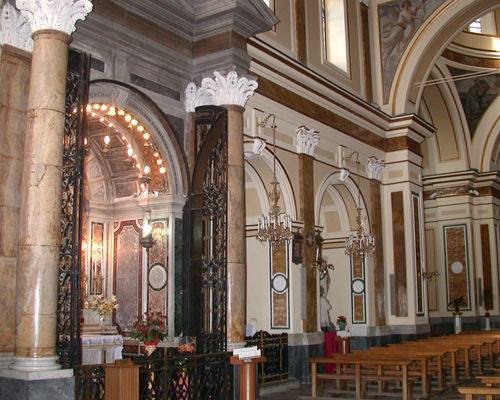
Altars on the left of the church
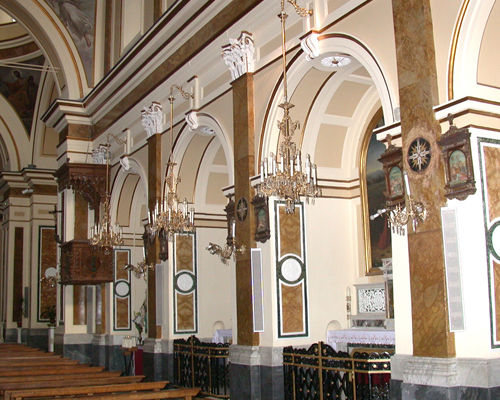
Altars to the right of the church
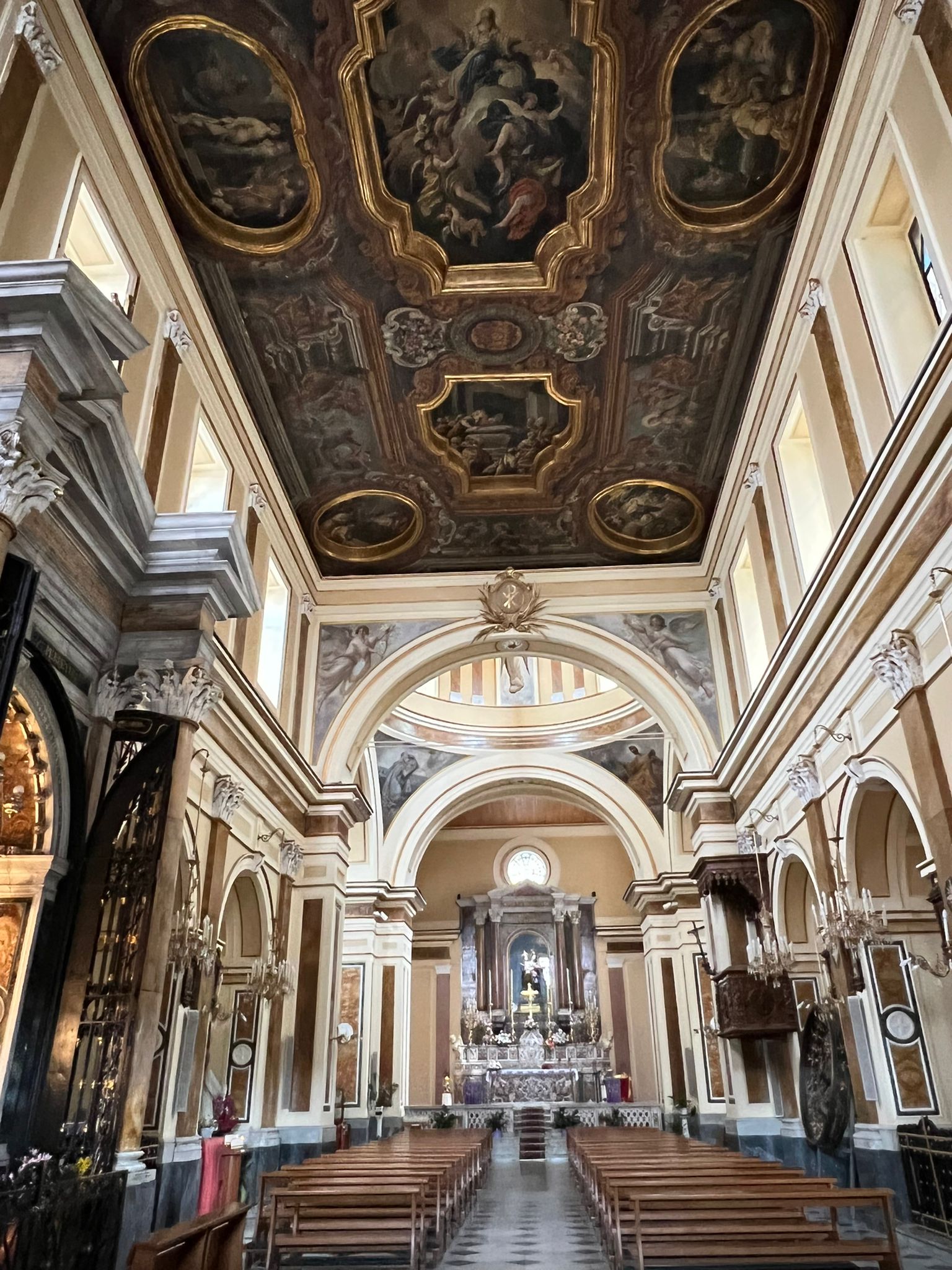
Central nave of the church
Altars on the left of the church
1. The tomb of Don Francesco de Lucia, first Rector of the Sanctuary born in the town and first devotee of St. Philomena. His work was honored by the privilege of being buried inside the Sanctuary. His tomb was restored in 2005 and the bronze bust placed above in his memory.
2. Chapel of the Crucifix – the chapel of confession. It is a spiritual place of reflection and reconciliation. The confessionals date from 1974. The Crucifix is from 1600. Found in the Sanctuary by Mons. Braschi, it was restored and returned to its natural state by Luigi Falco, who had it analyzed and dated in Milan. The altar is made up of three marbles: 1600, 1700, and 1800. In this chapel there remains a “Lapide,” a piece of marble with historical information regarding the devotion. The stained glass window was donated by the center of the Archconfraternity in Scotland. Outside this chapel, located near the doors, there is a statue of St. Joseph from 1700, restored in 2002.
3. Altar of Saint Philomena - August 10, 1805. This is the new altar that was donated in 1877 by the French people led by Mr. Garrigou at the time of Don Luis Petit, who founded the confraternity in France. The oil lamp was lit at the moment when Saint Philomena was placed on the altar. Inside the urn is the papier-mâché statue of Saint Philomena containing the body of the Saint. At the bottom left is the vial containing the dried blood of Saint Philomena. In front of this altar, the miracle to Blessed Pauline Jaricot occurred.
4. Miraculous Altar – this is the original altar of the chapel of Saint Philomena. It was moved in 1875 for the construction of a new and more elaborate altar. This is known as the miraculous altar because while it was being installed, the altar table broke into two pieces. Despite this, the work continued and in the end, the sculptor miraculously found the altar reassembled without any damage. At this altar, many Cardinals and Bishops, including Pope Pius IX, have celebrated Mass.
5. Statue of Saint John Vianney and Saint Philomena – Papier-mâché statue from a famous art school in Lecce, southern Italy, in 1890. The Sanctuary commissioned this work to demonstrate the great love and devotion that Saint John Vianney had for our Saint, he who also brought the great devotion of the holy cord, a sacramental of Saint Philomena. Many miracles are attributed to the latter.
6. Saint Anne with her daughter Mary as a child – work from around 1896, donated in 2003 by Dr. Elvira Vasta.
7. Reliquary of the Holy Martyrs – Dates back to 1700. Ancient collection of relics of various saints and martyrs. The most famous is Saint John Vianney. The latter was made by the artist Gennaro Ippolito
8. Miraculous Statue of Saint Philomena – In 1806 Cardinal Luigi Ruffo Scilla (1750-1832), Archbishop of Naples (1802-1832), donated to the Sanctuary a wooden statue of Saint Philomena containing in the chest cavity a reliquary that enclosed a small bone fragment belonging to the Martyr, as reported by Ippolito.
This statue is carried every year in procession through the streets of Mugnano del Cardinale, on the second Sunday of August. On August 10, 1823, during the procession, the statue became heavier; the next day and for 3 consecutive days, the statue sweated the fragrant “manna.” In this regard, there are two public registers; one signed by the Vicar Forane and by 17 priests of the clergy of Mugnano del Cardinale, the other by the Mayor, the Chancellor, and the Members of the Council. Such acts have been deposited at the Municipal Archive and in the Church of the Madonna delle Grazie. To commemorate this, a marble inscription was placed in the Church of the Madonna delle Grazie. The arch of this statue was restored in 2005 and donated by Beniamino Schettino.
The statue and the people of Mugnano del Cardinale were blessed by Pope Francis during the audience of May 10, 2023 <<.photos>> <<videos>>.
9. Saint Pio of Pietrelcina – commissioned and donated to the Sanctuary by Sister Bertilla (1934 – 2011) who dedicated 25 years of continuous service to the Sanctuary and the devotion to St. Philomena. Through her faithful service, the Sanctuary has become the home of devotees from all over the world, a place of rest for pilgrims.


Tomb of Don Francesco De Lucia
Side chapels
Statue of St. John Vianney and St. Philomena


Altars to the right of the church
1. Chapel of Saint Anthony – the statue dates back to around 1750. Every year, his feast is celebrated in the town in June. The feast predates the arrival of the body of Saint Philomena in this church.
2. Chapel of the Tomb of St. Philomena – these are the original panels from the tomb of St. Philomena discovered in the catacombs of St. Priscilla in 1802. Donated to the Sanctuary by Pope Leo XII. The image above this altar depicts the martyrdom of Saint Philomena. It was painted in the Royal Palace of Caserta in 1859.
3. Chapel of St. Rose of Lima and St. Catherine of Alexandria the painting dates back to around 1550.
4. Bronze sculpture of Saint Philomena – created in 2005 to commemorate the 200th anniversary of the transfer of the sacred body of Saint Philomena from Rome to Mugnano del Cardinale.
5. Entrance to the Sacristy – restored in 2002 thanks to the donation of the 1st Battenti group and by Paolo Corbisiero and Antonietta Braschi
6. Entrance to the Pilgrims' House
7. Statue of the Sacred Heart of Jesus – dating to around 1896, this statue has never been restored.


Dome


The church was built in the shape of a Latin cross with a single nave, an elegant dome in Renaissance style, and an altar adorned with precious and rare marbles. Inside the dome are depicted the four evangelists: Matthew, Mark, Luke, and John.


The four evangelists depicted inside the dome
Door
The bronze door of the Sanctuary of Saint Philomena was sculpted by Guglielmo Savini and donated by the municipality of Mugnano del Cardinale. The portal is composed of 6 bas-relief panels depicting the history of the Sanctuary.
The first panel of the door on the left shows the construction of the Church of Madonna delle Grazie. In the central panel, the translation of the sacred body of Saint Philomena is depicted, while in the third panel the Curé of Ars is shown promoting the glories of Saint Philomena.
The first panel on the right shows Saint Philomena protecting the town of Mugnano del Cardinale. In the central panel, the miracle of Pauline Jaricot that occurred on August 8, 1835, is depicted. In the last panel at the bottom, Saint Philomena is shown with the royal family of Naples and the Popes wishing hope for peace for the family of Saint Philomena.
The base of the portal bears the year of construction and the symbols of Saint Philomena and the symbol of the city of Cardinal Mugnano.
The portal was blessed by Cardinal Luigi Poggi during the Jubilee of 2000.

Bronze door of the Sanctuary
Bronze door of the Sanctuary
Museum
It represents the story of Saint Philomena in the various stages of martyrdom suffered at the hands of Emperor Diocletian.


The museum of Saint Philomena
Ceiling
The central ceiling of the church has a wooden panel in Baroque style from the early 1600s (17th century), by an unknown author. The coffered ceiling is composed of 9 panels, 3 central and 6 lateral. The three central panels represent the glory of Mary: the first panel depicts the Dormition, the central one the Assumption of Mary into heaven, and the third the Coronation. The six lateral panels represent the most important moments in the lives of Jesus and Mary. In other rectangular frames, the theological virtues are depicted.


Central ceiling in Baroque style
Organ
Work created at the end of the 20th century, on the occasion of the celebration of the first centenary of the translation of the body of Saint Philomena. The sound box is inlaid with gold. The work was carried out by Neapolitan artists and by the architect Ippolito.


Organ with a sound box inlaid with gold

Copyright 2023 © All right reserved